Achieving Exactly-Once Semantics (EOS) in Apache Kafka: A Practical Implementation Guide
Kafka exactly-once semantics only make sense when you connect them to the wider delivery-guarantee model: at-most-once, at-least-once, and exactly-once. From there, the real implementation levers are idempotent producers, transactions, and careful consumer behavior.
The first boundary matters: idempotence prevents duplicate writes caused by a producer retry. Transactions can make Kafka output records and consumed offsets atomic in a read-process-write path. Neither mechanism automatically makes a database write, API call, or other external side effect exactly once.
Understanding Message Delivery Guarantees
Before diving into EOS, let's quickly recap the common message delivery guarantees:
- At-Most-Once: Messages may be lost but are never redelivered. This is the "fire and forget" approach, suitable for non-critical data where loss is acceptable.
- At-Least-Once: Messages are never lost but may be redelivered. This is Kafka's default guarantee for producers if retries are enabled and
acksis not0. Applications must be designed to handle potential duplicates, for example through idempotent consumers or deduplication logic. - Exactly-Once: Messages are delivered and processed precisely once. This is the most desirable but also the most complex to achieve.
| Semantic | Message Loss | Message Duplication | Typical Use Case |
|---|---|---|---|
| At-Most-Once | Possible | No | Metrics, logging where occasional loss is tolerable |
| At-Least-Once | No | Possible | Most general use cases, with downstream deduplication |
| Exactly-Once | No | No | Financial transactions, critical state updates, billing systems |
How Apache Kafka Achieves Exactly-Once Semantics
Kafka achieves EOS through a combination of two key features: idempotent producers and transactions, built upon a foundation of reliable replication and leader election.
1. Idempotent Producer
An idempotent operation is one that can be performed multiple times with the same effect as if it were performed only once. In Kafka, the idempotent producer ensures that producer retries, due to transient network issues for example, do not result in duplicate messages being written to a topic partition.
How it works: When idempotence is enabled (enable.idempotence=true), the producer is assigned a unique Producer ID (PID) and maintains a sequence number for each message sent to a specific topic-partition. The broker keeps track of the highest sequence number successfully written for each PID. If the producer retries sending a message with a sequence number less than or equal to the one already acknowledged by the broker for that PID and partition, the broker discards the duplicate message but still sends an acknowledgment to the producer.
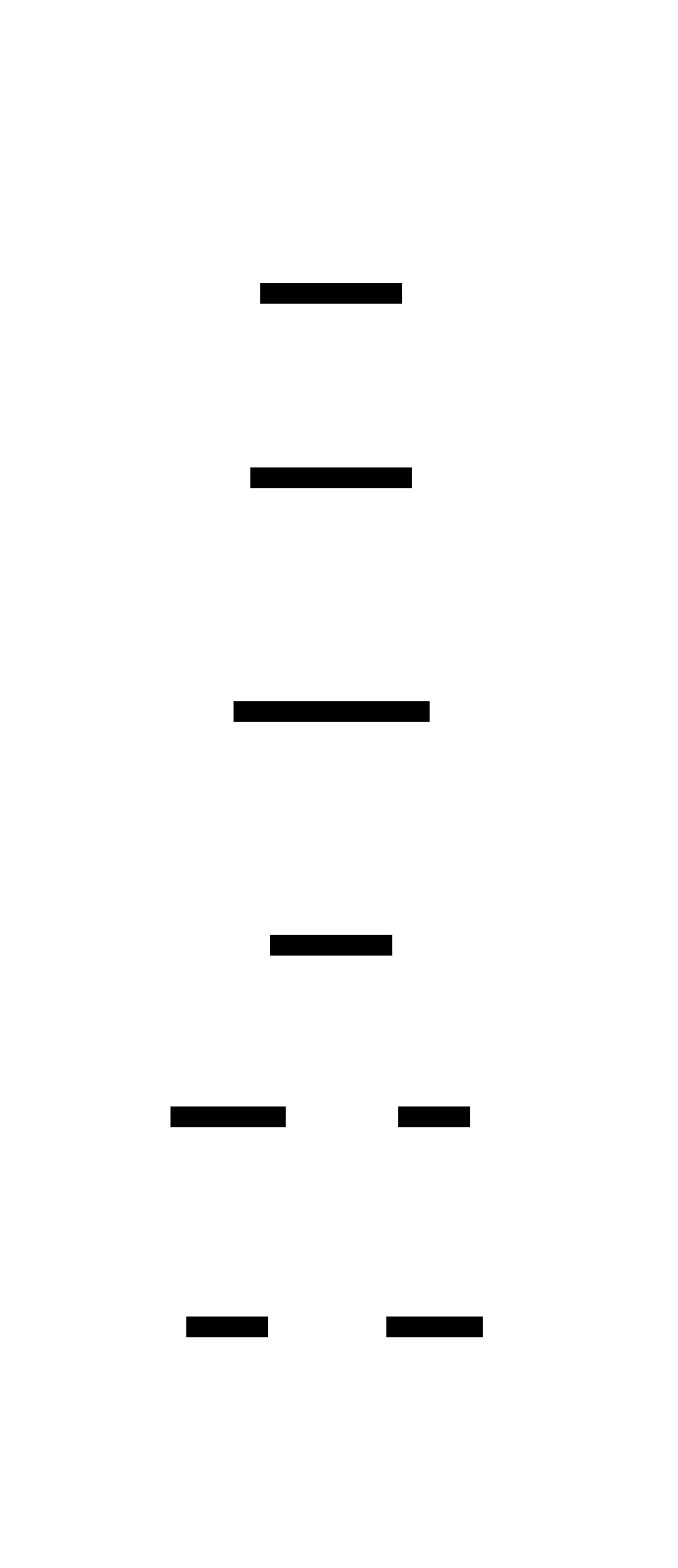
Diagram 1: Idempotent Producer Flow. The broker uses PID and sequence numbers to detect and discard duplicates from producer retries.
Key configurations for an idempotent producer:
enable.idempotence=true: Enables idempotence.- This implicitly sets:
acks=all: Ensures the leader waits for all in-sync replicas to acknowledge the write.retries > 0: For example,Integer.MAX_VALUEfor robust retrying.max.in.flight.requests.per.connection=5or less. Kafka can maintain ordering with idempotence enabled.
2. Kafka Transactions (Atomic Read-Process-Write)
While idempotence solves producer-side duplicates, EOS often involves consuming messages, processing them, and producing new messages atomically in a read-process-write pattern. Kafka transactions allow grouping multiple produce operations and consumer offset commits into a single atomic unit.
How it works:
- Initialization: The producer is configured with a unique
transactional.id. This ID allows the producer to maintain its transactional state across application restarts. The producer callsinitTransactions(). - Begin Transaction: The producer calls
beginTransaction(). - Consume-Process-Produce:
- The application consumes messages.
- It processes them.
- It produces new messages using the transactional producer via
producer.send(). These messages are staged and not visible to consumers withisolation.level=read_committeduntil the transaction is committed. - It sends consumer offsets to the transaction coordinator using
producer.sendOffsetsToTransaction(). This links the consumed offsets with the current transaction.
- Commit/Abort Transaction:
- If processing is successful, the producer calls
commitTransaction(). The transaction coordinator then orchestrates a two-phase commit protocol to make all produced messages and committed offsets visible atomically. - If an error occurs, the producer calls
abortTransaction(). All staged messages are discarded and offsets are not committed.
- If processing is successful, the producer calls
A central component called the Transaction Coordinator, running on a Kafka broker, manages the state of transactions.
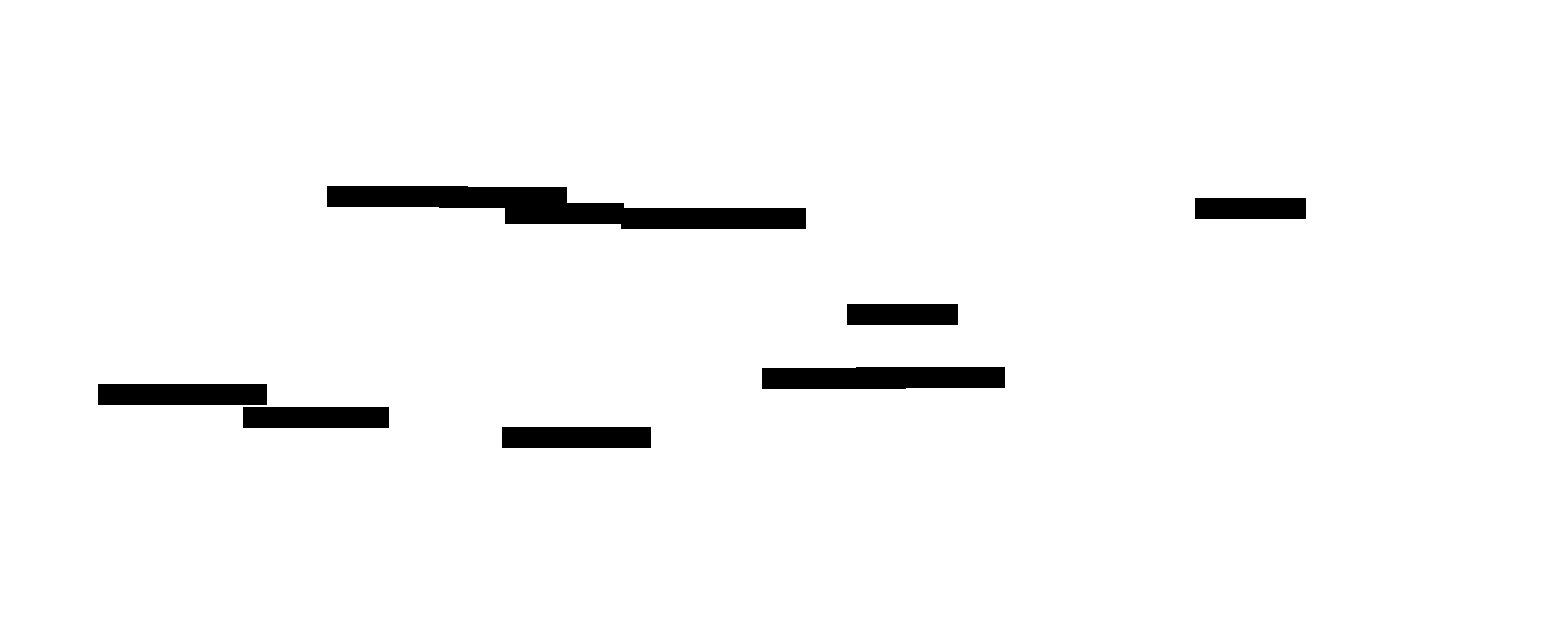
Diagram 2: Kafka Transactional Producer Flow with Transaction Coordinator.
Consumer Configuration for EOS
For consumers to only read committed transactional data, they must be configured with:
isolation.level=read_committed: This ensures the consumer only reads messages that are part of a successfully committed transaction. It will not read messages from ongoing or aborted transactions. The default isread_uncommitted. Aread_committedconsumer can read only up to the last stable offset while a transaction remains open, so long transactions can delay visibility. See the official consumer configuration reference.
Practical Implementation Guide
Enabling Idempotence (Producers)
This is the simplest step toward EOS and protects against producer-retry duplicates.
// Java Producer Configuration for IdempotenceProperties props = new Properties();props.put("bootstrap.servers", "kafka-broker1:9092,kafka-broker2:9092");props.put("key.serializer", "org.apache.kafka.common.serialization.StringSerializer");props.put("value.serializer", "org.apache.kafka.common.serialization.StringSerializer");
// Enable idempotenceprops.put("enable.idempotence", "true");// The following are typically set by enable.idempotence=true, but good to be aware of:// props.put("acks", "all"); // Ensures durability// props.put("retries", String.valueOf(Integer.MAX_VALUE)); // Retry indefinitely or a large number// props.put("max.in.flight.requests.per.connection", "5"); // Kafka handles ordering correctly with idempotence
Producer<String, String> producer = new KafkaProducer<>(props);
try {    producer.send(new ProducerRecord<>("my-topic", "key", "message-value-1")).get();    producer.send(new ProducerRecord<>("my-topic", "key", "message-value-2")).get();} catch (InterruptedException | ExecutionException e) {    e.printStackTrace();} finally {    producer.close();}
Implementing Transactions (Producers and Consumers)
This provides atomicity for read-process-write patterns.
// Java Transactional Producer ExampleProperties producerProps = new Properties();producerProps.put("bootstrap.servers", "kafka-broker1:9092");producerProps.put("key.serializer", "org.apache.kafka.common.serialization.StringSerializer");producerProps.put("value.serializer", "org.apache.kafka.common.serialization.StringSerializer");producerProps.put("enable.idempotence", "true");producerProps.put("transactional.id", "my-unique-transactional-id");
Producer<String, String> producer = new KafkaProducer<>(producerProps);producer.initTransactions();
try {    producer.beginTransaction();
    // Simulate consuming messages (in reality, this would come from a KafkaConsumer)    // Map<TopicPartition, OffsetAndMetadata> offsetsToCommit = ... ;
    producer.send(new ProducerRecord<>("output-topic-1", "key1", "processed-value-1"));    producer.send(new ProducerRecord<>("output-topic-2", "key2", "processed-value-2"));
    // producer.sendOffsetsToTransaction(offsetsToCommit, "my-consumer-group-id");
    producer.commitTransaction();    System.out.println("Transaction committed successfully.");
} catch (ProducerFencedException | OutOfOrderSequenceException | AuthorizationException e) {    System.err.println("Fatal error during transaction: " + e.getMessage());    producer.close();    throw e;} catch (KafkaException e) {    System.err.println("Error during transaction, aborting: " + e.getMessage());    try {        producer.abortTransaction();    } catch (KafkaException abortException) {        System.err.println("Error aborting transaction: " + abortException.getMessage());    }} finally {    producer.close();}
// Java Consumer Configuration for EOSProperties consumerProps = new Properties();consumerProps.put("bootstrap.servers", "kafka-broker1:9092");consumerProps.put("group.id", "my-eos-consumer-group");consumerProps.put("key.deserializer", "org.apache.kafka.common.serialization.StringDeserializer");consumerProps.put("value.deserializer", "org.apache.kafka.common.serialization.StringDeserializer");consumerProps.put("enable.auto.commit", "false");consumerProps.put("isolation.level", "read_committed");
Expert Insight: Transactional ID Uniqueness
The `transactional.id` must be unique across all running producer instances. If multiple producer instances use the same `transactional.id`, older instances will be fenced off by the broker with a `ProducerFencedException` to prevent zombie instances from interfering with the active one. Careful management of `transactional.id` is critical, especially in dynamically scaled environments.
Kafka Streams and EOS
Apache Kafka Streams significantly simplifies implementing EOS for stream processing applications. By default, Kafka Streams provides at-least-once processing guarantees. To enable EOS, you can set:
processing.guarantee="exactly_once_v2"on supported current Kafka releases.
The older exactly_once configuration names are deprecated in current Kafka. With exactly_once_v2, Kafka Streams manages producer idempotence, transactions for read-process-write-update-state operations, and consumer offset commits atomically. Confirm the broker/client compatibility requirements in the current Kafka Streams configuration reference.
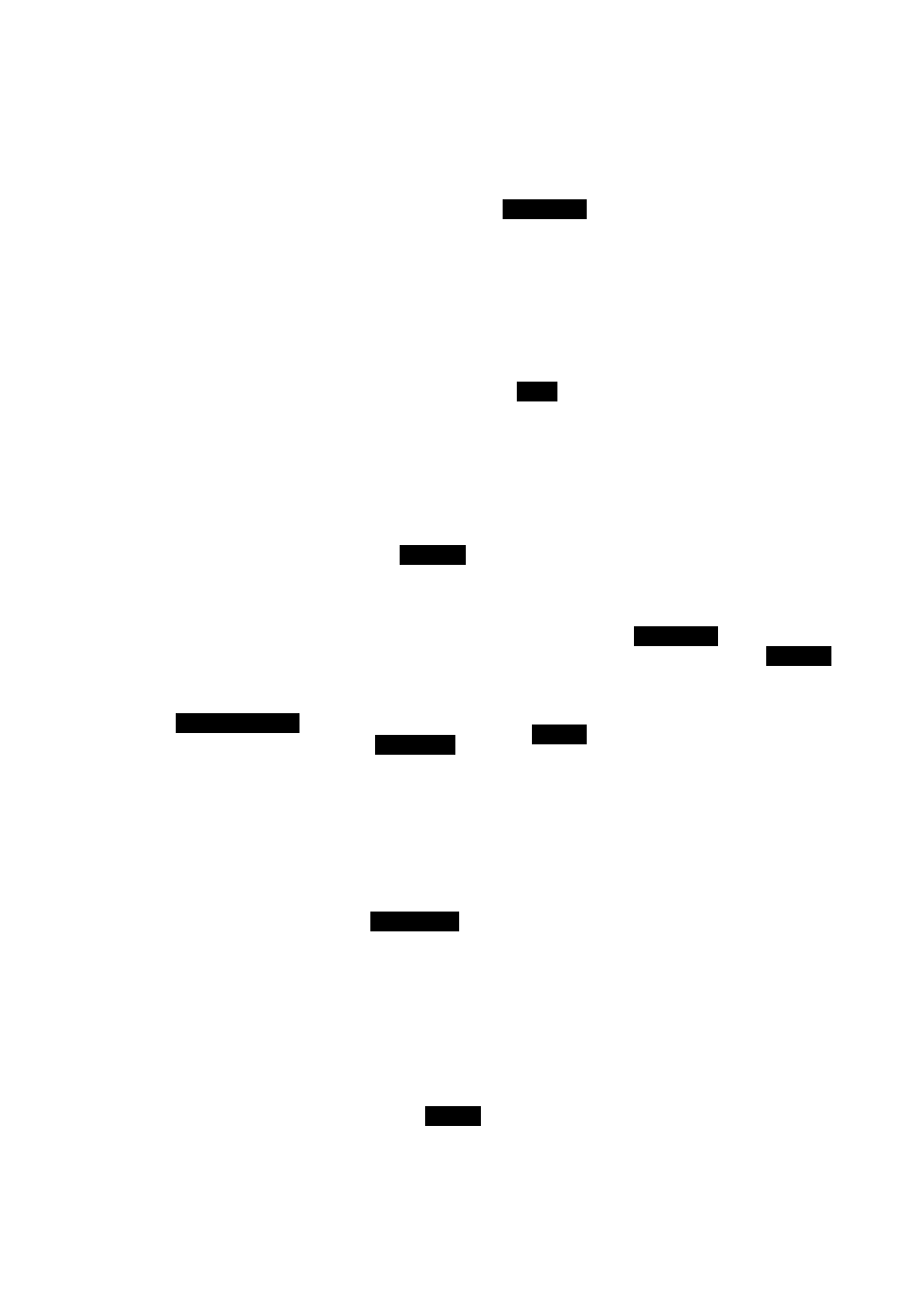
Diagram 3: Conceptual Read-Process-Write-Update State Cycle in Kafka Streams with EOS.
Key Configurations for EOS
Here's a quick reference for the most important configurations related to EOS:
| Scope | Parameter | EOS Recommended Value | Description |
|---|---|---|---|
| Producer | enable.idempotence | true | Enables idempotent message delivery. |
| Producer | acks | all | Leader waits for all ISRs to acknowledge. Set automatically by enable.idempotence=true. |
| Producer | retries | Integer.MAX_VALUE or another large number | Enables retries on transient errors. |
| Producer | transactional.id | Unique string per logical producer | Enables transactional capabilities for the producer. Must be unique. |
| Producer | max.in.flight.requests.per.connection | 1 to 5 | With enable.idempotence=true, Kafka guarantees ordering even with this up to 5. |
| Consumer | isolation.level | read_committed | Ensures the consumer only reads messages from committed transactions. |
| Consumer | enable.auto.commit | false | Required when managing offsets as part of a transaction or manually. |
| Broker | transaction.state.log.replication.factor | >= 3 for production | Replication factor for the internal transaction log topic. |
| Broker | transaction.state.log.min.isr | 2 when replication factor is 3 | Minimum ISR count for the transaction log topic. |
| Kafka Streams | processing.guarantee | exactly_once_v2 | Enables EOS for Kafka Streams applications. |
Best Practices and Considerations for EOS
- Thoroughly Test Your Application: EOS behavior, especially under failure scenarios like broker restarts, network partitions, and consumer crashes, needs rigorous testing.
- Manage
transactional.idCarefully: Ensure uniqueness and proper lifecycle management, especially in dynamic or containerized environments. - Keep Transactions Short: Long-running transactions can increase load on the transaction coordinator, increase the risk of timeouts, and delay visibility for
read_committedconsumers. - Monitor Transactional Applications: Pay close attention to Kafka metrics related to transactions, such as transaction coordinator load, transaction rates, abort rates, and fencing counts.
- Understand Performance Implications: EOS introduces overhead compared to at-least-once delivery. Benchmark your workload to understand the impact on throughput and latency.
- Handle
ProducerFencedExceptionGracefully: This indicates another producer instance with the sametransactional.idhas started. The current instance should shut down cleanly. - Error Handling is Key: Implement robust error handling for Kafka exceptions. Decide when to abort a transaction and retry, and when an error is fatal for the producer instance.
Expert Insight: When is EOS Truly Necessary? While EOS is powerful, it's not always required. If your downstream systems can handle duplicates idempotently, for example by using unique keys in a database UPSERT operation, at-least-once delivery from Kafka combined with downstream deduplication might be a simpler and more performant solution.
Common Pitfalls and How to Avoid Them
- Mismatched Producer and Consumer Configurations: Forgetting
isolation.level=read_committedon consumers when producers are transactional is a common mistake, leading to consumers seeing uncommitted data. - Incorrect
transactional.idManagement: Reusingtransactional.idvalues inappropriately can lead to fencing, especially in dynamic environments. - Transaction Timeouts: If processing within a transaction takes longer than the configured timeout, the broker may abort the transaction or the consumer may be removed from the group.
- Not Handling Fencing or Sequence Exceptions: Ignoring
ProducerFencedExceptionorOutOfOrderSequenceExceptioncan lead to unstable producer behavior. - Underestimating Operational Overhead: Transactional systems require more careful monitoring and deeper understanding of broker-side coordinator behavior.
Beyond Kafka: End-to-End Exactly-Once
Kafka's EOS applies to the Kafka transaction boundary. If your application interacts with a database, API, or another queue, that external side effect is not made atomic merely by setting transactional.id. The official producer configuration also makes the narrower distinction explicit: transactional.id enables transactional delivery, while a missing ID leaves the producer idempotent only.
For an external sink, choose a boundary that can survive replay:
- use an idempotency key or deterministic upsert in the destination;
- write an outbox record in the same database transaction as the business state, then publish it through change data capture;
- use a connector whose delivery and replay behavior you have tested;
- reserve a distributed transaction for the rare case where every participant supports it and the operating cost is justified.
The acceptance test is a forced crash at each boundary: before the external write, after the write but before the offset/transaction commit, and after the commit. If replay changes the final business state, the path is not end-to-end exactly once.
Glossary of Terms
- PID (Producer ID): A unique identifier assigned to a Kafka producer when idempotence is enabled. Used with sequence numbers to prevent duplicate messages from producer retries.
- Sequence Number: A per-partition, monotonically increasing number assigned by an idempotent producer to each message. Helps brokers detect and discard duplicates.
- Transactional ID (
transactional.id): A unique identifier configured on a Kafka producer to enable transactional capabilities and maintain state across restarts. - Transaction Coordinator: A Kafka broker component responsible for managing the lifecycle of transactions.
- Isolation Level (
isolation.level): A Kafka consumer configuration (read_committedorread_uncommitted) that determines whether a consumer can read messages that are part of uncommitted transactions. - ProducerFencedException: An exception thrown by a transactional producer when another producer instance with the same
transactional.idhas been initialized.
Conclusion
Apache Kafka provides powerful mechanisms - idempotent producers and atomic transactions - to achieve Exactly-Once Semantics. While implementing EOS requires careful configuration, robust error handling, and an understanding of the underlying principles, it is an attainable goal for applications demanding the highest level of data integrity.
Use these features when the Kafka-side atomicity is required, and use destination-side idempotency or an outbox when the workflow crosses Kafka's transaction boundary. The distinction is more important than the label "exactly once."